
BC Centre for Disease Control (BCCDC)
This project aims to strengthen the province's capacity to anticipate, reduce, and manage climate risks while supporting disproportionately impacted communities and ecosystems. By recognizing the unique needs of different regions and communities, particularly those in rural, remote, and Indigenous areas, B.C. can develop, collaboratively with communities, more effective and equitable adaptation strategies that incorporate local knowledge and address specific vulnerabilities.
Background
Addressing the complex and interconnected impacts of climate change in B.C. requires a strategic, evidence-based approach to ensure that climate adaptation is effective and equitable. Climate adaptation refers to the actions taken to prepare for and respond to the impacts of climate change, reducing risks and enhancing resilience in communities, ecosystems, and infrastructure. The adaptive capacity project requires utilizing complex, strategic, and holistic approaches, focusing on relationship building, ground-level engagement, reciprocity, and accountability to facilitate community uptake and support in adaptive capacity building successfully. The inadequacy of current methods for supporting communities with climate adaptive capacity is a critical gap in B.C.’s policy, environmental, and health systems. Numerous frameworks for adaptive capacity exist, but most operate at scales that fail to capture local-level implementation assets, enablers, and constraints to specific priority populations. Place-based, local, and Indigenous knowledge systems are key to understanding how these communities can adapt to climate change impacts.
Objectives
Objective 1: Strengthen B.C.’s capacity to anticipate, reduce, and manage climate risks
Objective 2: Recognize unique regional and community needs, especially in rural, remote, and Indigenous communities
Objective 3: Lay a foundation for developing more effective and equitable adaptation strategies in collaboration with communities utilize the evidence gathered in this research to develop funding applications to conduct a next phase of research directly with women and girls.
Findings
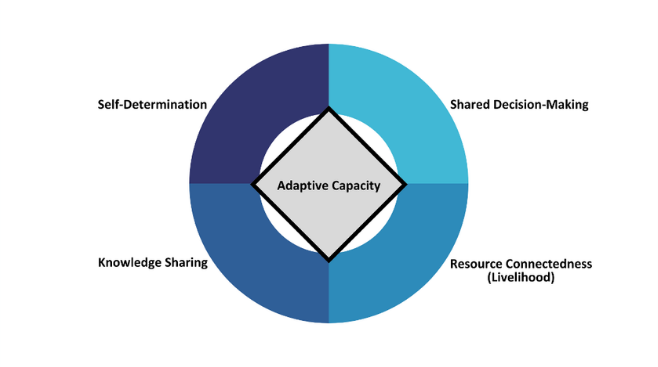
Theme 1: Shared Decision-Making
By investing in equitable and culturally tailored capacity-building partnerships, these collaborative efforts bridge gaps between policy and practice, ensuring adaptation strategies are structured and culturally resonant
Theme 2: Resource Connectedness (Capital)
Many articles use the term ‘capital’ to refer to the availability of resources and the community's ability to access and use these resources.7 In an attempt to apply an equity lens and move away from terms that evoke a militaristic sentiment, the term resource connectedness (RC) will be used in its place
Theme 3: Knowledge Sharing
By establishing channels where climate-related information is readily available and can flow freely, communities can address adaptation on several different levels
Theme 4: Self-Determination
Rather than relying solely on top-down policies and initiatives, self-determined climate adaptation ensures that locals lead the response, integrating traditional knowledge with scientific expertise to build resilience and sustainability, improving the community's overall adaptive capacity